
 English
 中文简体
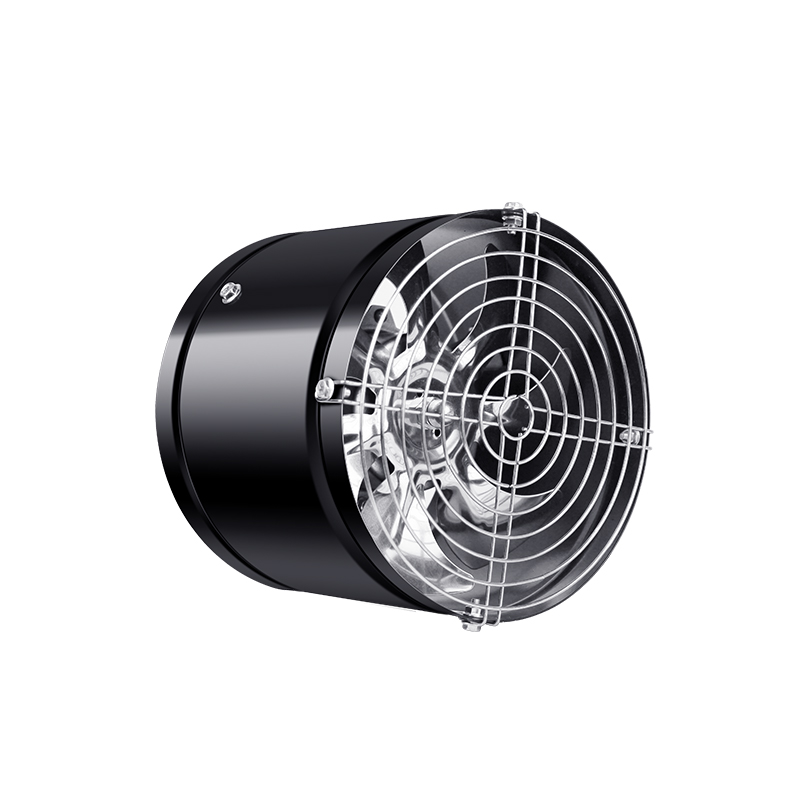
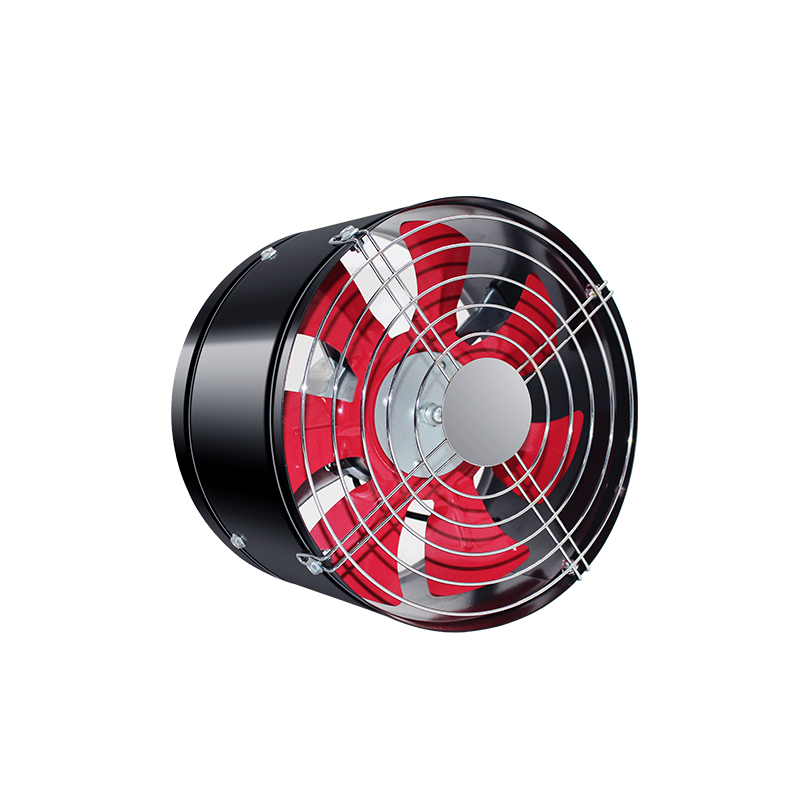
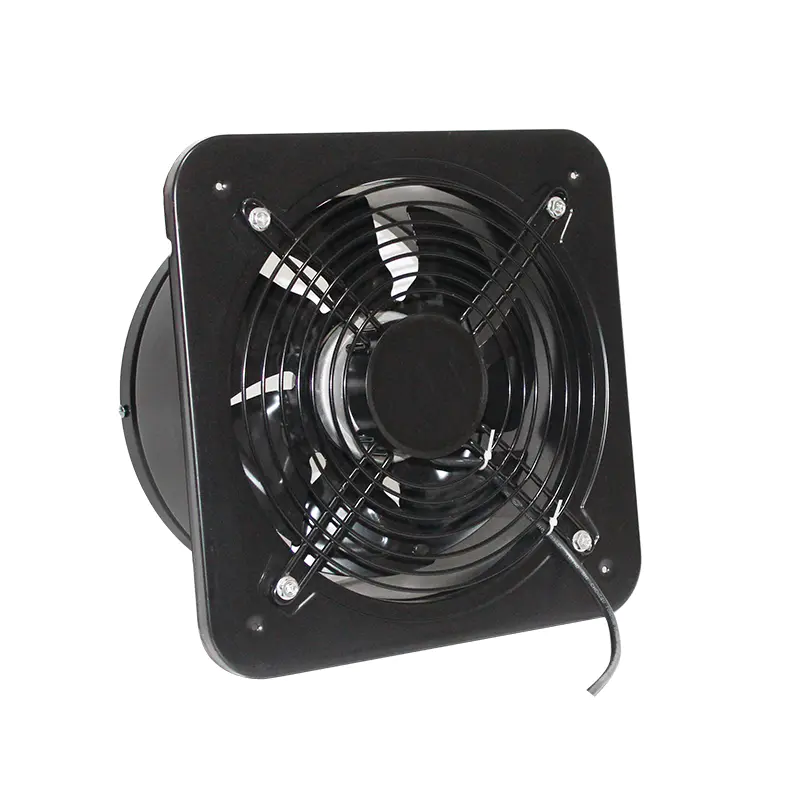
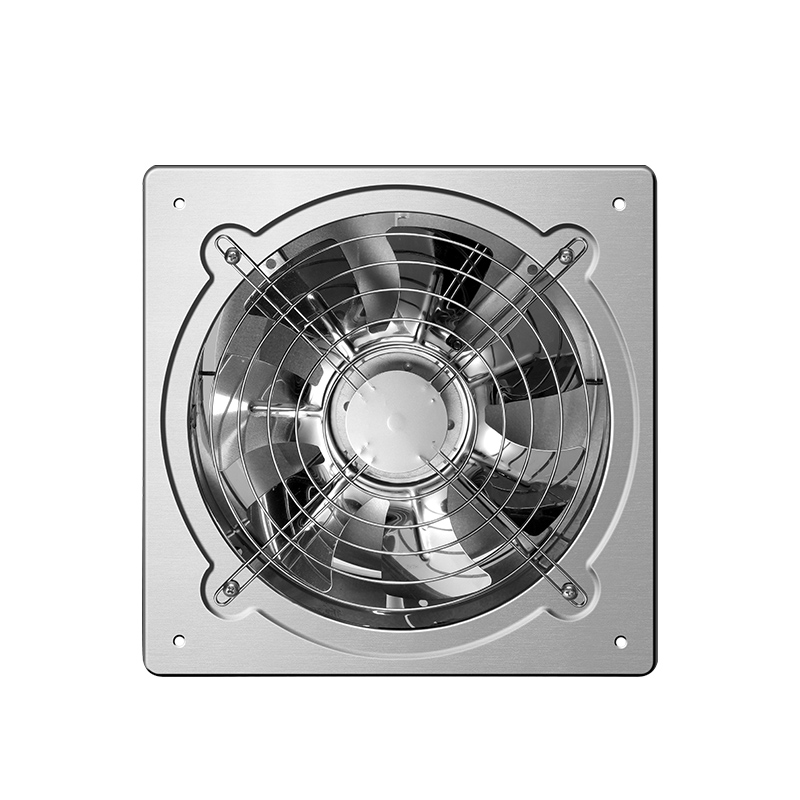
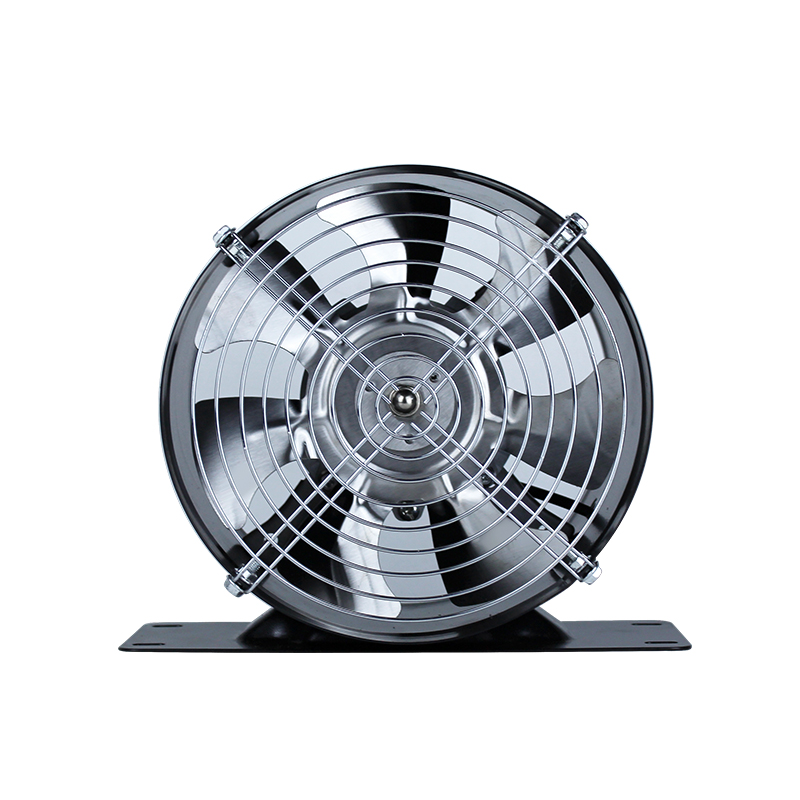
中文简体An axial fan works by rotating a set of angled blades around a central hub, pulling air in along the axis of rotation and discharging it in the same axial direction — parallel to the shaft. The blades act as rotating aerofoils: as they spin, a pressure differential develops between the leading and trailing surfaces of each blade, accelerating air rearward in the direction of blade travel. This mechanism is identical in principle to an aircraft propeller or helicopter rotor, and it is precisely why axial fans move very large volumes of air efficiently at low static pressure — making them the dominant fan type in HVAC systems, cooling towers, air handling units, data centres, industrial ventilation, and automotive engine cooling worldwide.
How an Axial Fan Works — The Physics Explained
The operating principle of an axial fan is rooted in aerofoil theory. Each blade of the fan is profiled in cross-section like an aircraft wing — curved on one face and flatter on the other. When the blade rotates, the air travelling over the curved (suction) face must travel a longer path than air on the pressure face, creating a lower static pressure on the suction side and higher static pressure on the pressure face. This pressure differential produces lift — or in the case of a fan blade oriented parallel to the airflow, it produces a net axial thrust that accelerates air through the fan disc.
The Role of Blade Angle (Pitch)
The angle at which each blade is set relative to the plane of rotation — called the pitch angle or angle of attack — is the primary variable that determines how the fan performs. A steeper pitch angle moves more air per revolution but requires more motor torque and power. A shallower pitch moves less air but operates at higher efficiency at low-load conditions. The relationship between pitch angle, airflow, and pressure is captured in the fan's performance curve:
| Blade Pitch Angle | Airflow Volume | Static Pressure | Power Consumption | Typical Application |
|---|---|---|---|---|
| 10 – 15 degrees (shallow) | Low | Low | Low | Gentle circulation, comfort fans |
| 20 – 30 degrees (medium) | Medium to high | Medium | Medium | HVAC units, general ventilation |
| 35 – 45 degrees (steep) | High | High | High | Cooling towers, industrial extraction |
| Variable pitch (adjustable) | Varies on demand | Varies on demand | Optimised at each operating point | Large cooling towers, mining ventilation |
Velocity Components and Energy Transfer
When air passes through a rotating axial fan, it acquires three velocity components simultaneously: axial velocity (useful — the air moves forward through the fan), tangential velocity (partially useful — swirl that can be recovered by guide vanes), and radial velocity (minimal — negligible in well-designed axial fans). The total pressure rise across the fan represents the mechanical energy added to the air by the rotating blades. In a typical industrial axial fan operating at 1,450 RPM with a 1.2-metre diameter impeller, the blade tip speed reaches approximately 91 m/s, and the blade imparts a velocity increment to the airstream of 8–15 m/s depending on pitch angle and proximity to the hub versus tip.
Guide vanes — stationary aerofoil-shaped vanes fitted upstream (inlet guide vanes) or downstream (outlet guide vanes) of the rotating impeller — are used in higher-performance axial fans to convert the rotational component of the air's velocity into additional static pressure. A well-designed downstream guide vane set can recover 30–40% of the swirl energy that would otherwise be wasted, raising the fan's overall total-to-static efficiency from approximately 65% to 80% or above. This is why large cooling tower fans and mine ventilation fans almost always incorporate outlet guide vanes.
Key Components of an Axial Fan and What Each Does
-
Impeller (blade assembly)
The rotating component carrying 3 to 24 blades depending on design. Blades are typically cast aluminium, glass-reinforced plastic (GRP), or stamped steel, profiled as aerofoils with increasing twist from hub to tip to maintain a consistent angle of attack along the blade span as tip speed is higher than hub speed. The number of blades affects noise — more blades generally produce a higher-frequency, less tonal noise signature that is more acceptable in occupied buildings than the lower-frequency "thump" of 3-blade fans.
-
Hub and motor assembly
The central boss that connects the blades to the motor shaft. In direct-drive fans, the motor is mounted coaxially within or behind the hub. In belt-drive fans, the hub is mounted on a separate shaft connected to an offset motor via V-belts and pulleys. Direct-drive arrangements are more compact and eliminate belt maintenance but offer less flexibility in speed selection. Belt-drive arrangements allow speed adjustment by changing pulley diameters and are preferred in applications where flow rate adjustment without electronic speed control is required.
-
Casing (fan ring or cylinder)
The cylindrical housing that surrounds the impeller at a precise clearance — typically 1–3% of the blade tip diameter. The tip clearance between blade tips and casing is one of the most important dimensional tolerances in fan performance: a clearance of 1% of diameter is optimal for efficiency; clearances above 3% allow significant recirculation of high-pressure air from the discharge side back through the tip gap to the suction side, reducing effective airflow by 10–20% and increasing noise substantially. Fan rings also serve as the mounting interface to ductwork, walls, or equipment panels.
-
Inlet bell mouth or inlet cone
A smoothly curved inlet fitted to the suction face of the fan to guide incoming air toward the blade disc with minimum turbulence. An abrupt square-edged inlet causes flow separation at the inner corner, creating turbulent eddies that reduce effective inlet area by 15–25%. A well-designed bell mouth increases the fan's volumetric efficiency by maintaining a uniform, low-turbulence velocity profile across the blade disc. This component is often omitted in low-cost fan designs but is standard on precision industrial and HVAC units where efficiency and noise matter.
-
Outlet guide vanes
Stationary aerofoil vanes positioned downstream of the impeller to straighten the swirling air discharge and recover swirl energy as static pressure. Not present on all axial fans — smaller and simpler designs omit them — but essential on high-efficiency designs where total-to-static efficiency above 75% is required. The vanes are typically welded to the casing in a cascade arrangement with a specific stagger angle matched to the design operating point of the fan.
How Axial Fan Performance Is Measured and Specified
Understanding how axial fan performance is specified allows correct selection for a given application and prevents the common mistake of selecting a fan that delivers the required airflow at zero resistance (free delivery) but fails to achieve that flow when installed against the real system resistance. Every axial fan is characterised by a performance curve — a graph plotting static pressure rise against volumetric flow rate at constant speed:
| Performance Parameter | Unit | Typical Range (industrial axial) | Significance |
|---|---|---|---|
| Volumetric flow rate (Q) | m3/s or m3/h | 0.1 – 500 m3/s | Volume of air moved per unit time — the primary sizing criterion |
| Static pressure rise (Ps) | Pascals (Pa) | 50 – 2,000 Pa | Pressure the fan must overcome from system resistance (ductwork, filters, louvres) |
| Total pressure rise (Pt) | Pascals (Pa) | 100 – 2,500 Pa | Static pressure plus velocity pressure at outlet — total energy added to airstream |
| Total-to-static efficiency (nts) | Percentage (%) | 55 – 85% | Ratio of useful static pressure work output to shaft power input |
| Specific sound level (Ks) | dB(A) | 18 – 35 dB(A) | Noise generated at the design operating point — critical for occupied building installations |
| Shaft power (P) | Kilowatts (kW) | 0.01 – 1,000 kW | Motor power required at the design operating point |
The Fan Laws — How Performance Scales with Speed
The fan laws (derived from fluid dynamic similarity theory) define how an axial fan's performance changes when its rotational speed changes. These relationships allow engineers to predict performance at speeds not tested during manufacturer characterisation, and they underpin the energy savings achievable with variable speed drives (VSD):
-
Flow rate scales linearly with speed
If fan speed doubles, flow rate doubles. If speed is reduced to 80% of rated speed, flow falls to 80%. This linear relationship means a VSD can precisely control the delivered airflow without throttling, which wastes energy.
-
Static pressure scales with the square of speed
Reducing fan speed to 80% reduces static pressure to 64% (0.8 squared). This rapid pressure reduction at reduced speeds means axial fans become ineffective at very high system resistances when slowed down — an important limitation that distinguishes axial fans from centrifugal fans in high-resistance applications.
-
Power consumption scales with the cube of speed
This is the most commercially significant fan law. Reducing fan speed to 80% of rated speed reduces motor power consumption to 51% (0.8 cubed). A fan running continuously at 80% speed rather than 100% speed saves 49% of energy — for a 75 kW cooling tower fan, this represents approximately 36 kW of continuous saving, worth over $30,000 per year at $0.10/kWh running 8,760 hours annually.
Axial Fan Types and When Each Is Used
| Type | Configuration | Pressure Range | Efficiency | Primary Application |
|---|---|---|---|---|
| Propeller fan | Impeller only; no casing or guide vanes | Very low — 50 – 250 Pa | 40 – 60% | Wall exhaust fans, condenser coil cooling, air circulation |
| Tube axial fan | Impeller in cylindrical casing; no guide vanes | Low to medium — 200 – 800 Pa | 55 – 70% | Short duct runs, fume extraction, general ventilation |
| Vane axial fan | Impeller in casing with outlet guide vanes | Medium to high — 500 – 2,000 Pa | 70 – 85% | Long duct systems, HVAC air handling, tunnel ventilation |
| Counter-rotating axial fan | Two impellers rotating in opposite directions on same axis | High — 800 – 3,000 Pa | 75 – 88% | Mine ventilation, high-pressure duct systems, wind tunnels |
| Variable pitch axial fan | Impeller with mechanically adjustable blade pitch angle | Medium to high | 80 – 88% across wide range | Cooling towers, large HVAC plant, where demand varies significantly |
Why Axial Fans Are Chosen Over Centrifugal Fans
The choice between an axial fan and a centrifugal (radial) fan for a given application depends on the system resistance and the required flow-to-pressure ratio. Axial fans are chosen when:
-
High flow at low pressure is required
Axial fans achieve their highest efficiency at high flow rates and low static pressures — typically below 500 Pa for propeller types and below 1,500 Pa for vane axial types. This makes them the correct choice for cooling towers (where air must be moved through wet fill media at low resistance), large agricultural buildings, and data centre hot-aisle cooling where volumes of 5–50 m3/s per fan unit are required at pressures below 300 Pa.
-
In-line duct installation is required
Axial fans discharge in the same direction as they draw air, making them inherently in-line devices that fit naturally into straight duct runs without changing air direction. Centrifugal fans discharge at 90 degrees to their inlet, requiring a scroll housing and a right-angle transition that adds bulk, cost, and installation complexity. In tunnel ventilation, mine ventilation shafts, and long horizontal ductwork runs, the in-line geometry of axial fans is a decisive practical advantage.
-
Compact diameter-to-length ratio is needed
An axial fan's diameter is determined entirely by the airflow requirement — larger diameter means lower blade speed and lower noise for the same flow rate. A 1.5-metre diameter vane axial fan producing 25 m3/s occupies a fraction of the floor area of the equivalent centrifugal fan and can be installed in the duct without a separate fan room. This spatial efficiency makes axial fans dominant in building mechanical services where plant room space is at a premium.
-
Energy efficiency with VSD control is a priority
The cubic fan law relationship between speed and power, combined with the inherently high efficiency of modern aerofoil-bladed axial fans (total-to-static efficiency of 80–86% at the design point), makes axial fans with variable speed drives the most energy-efficient solution for variable-demand ventilation systems. Large data centres operating axial fans on VSD control routinely achieve PUE (Power Usage Effectiveness) values below 1.2 — meaning less than 20% of total facility power is used for cooling infrastructure rather than IT equipment.
Common Axial Fan Problems and Their Causes
| Problem | Most Likely Cause | Diagnostic Indicator | Corrective Action |
|---|---|---|---|
| Low airflow despite motor running | Fan installed in reverse rotation direction | Delivers approximately 50–60% of rated flow in reverse | Reverse two motor phase connections (3-phase) or check single-phase wiring |
| Excessive noise — tonal whine | Blade tip-to-casing clearance too large; blade imbalance | Noise increases sharply with speed; vibration at blade passing frequency | Check and correct tip clearance; rebalance impeller |
| Motor overheating | Fan operating in stall region; system resistance higher than design | Low airflow measured; motor current above nameplate | Reduce system resistance; check for blocked filters or closed dampers |
| Blade fatigue cracking | Operation at resonant speed; corrosion of aluminium or GRP blades | Visible cracks at blade root; vibration increase over time | Replace impeller; avoid operating at resonant speeds identified by vibration survey |
| Reduced flow over time | Blade surface contamination reducing aerofoil effectiveness | Gradual flow reduction; visual inspection shows deposits on blade faces | Clean blades with appropriate solvent; implement regular cleaning schedule |